The Perception Gap: What Men Get Wrong about Each Other and Health
Men are not disconnected by choice; they are disconnected by culture.
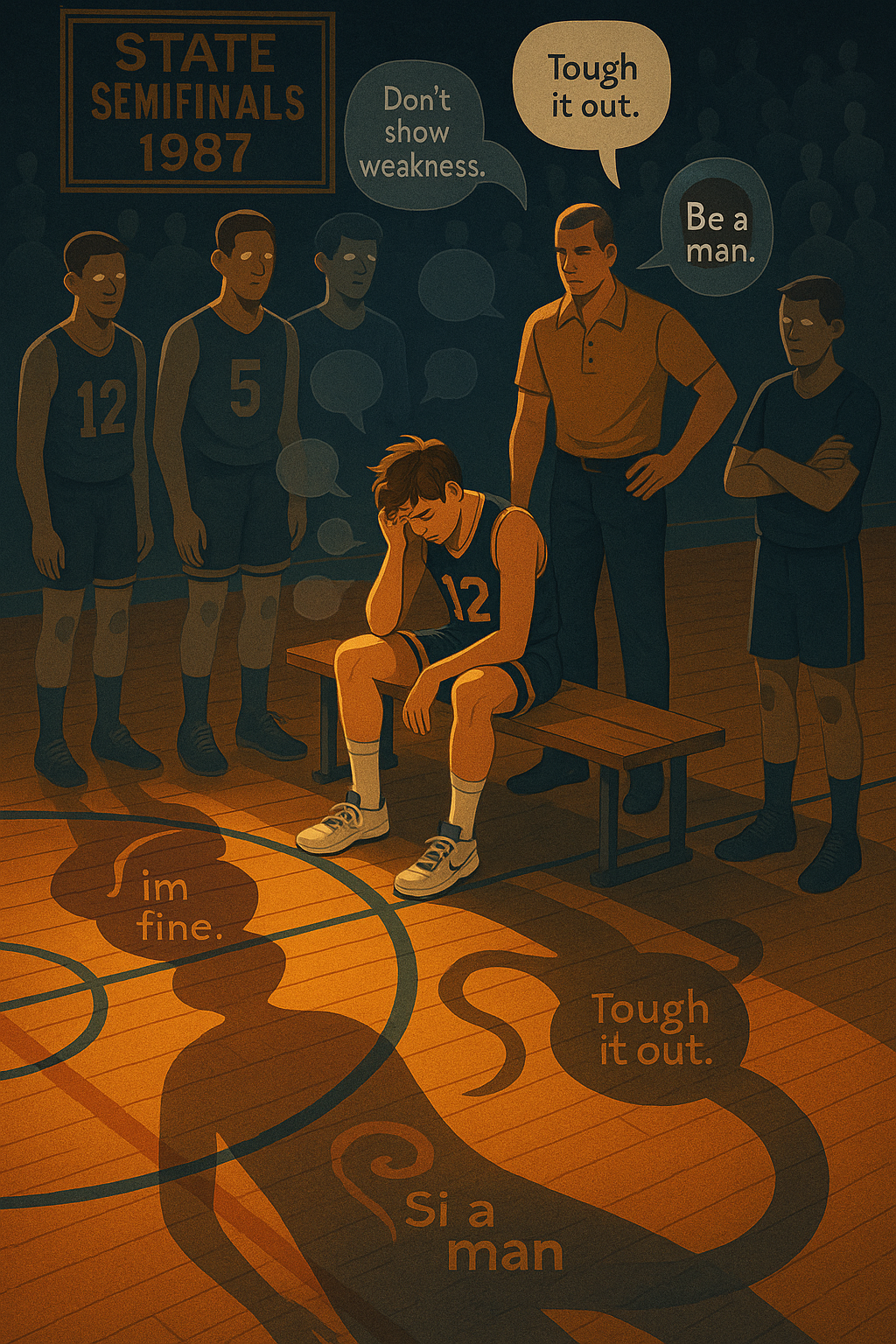
AI image of my concussion. My coach wasn’t so harsh IRL.
Introduction: The Relational Gap
At mid-court my head collided with the knee of an opposing player during a high school basketball scrimmage. I was definitely out for a moment or two. Someone helped me to the bench where I sat for a few minutes trying to pull myself together. An assistant coach kept asking if I was alright. It was 1987, and I was certainly concussed. This was before we learned about CTE and concussion training equated an ice-bag. With all the foolish machismo of a testosterone-filled 17-year-old, I brushed off the injury before my coaches and teammates and pestered my way back on the court. The headache later that night was miserable.
That moment captures a sort of stoicism spiral, a collision between pluralistic ignorance and precarious manhood. I believed that admitting pain would mean losing respect among my teammates, a belief shared by many young men who are silently misreading one another and performing toughness they don’t truly believe in. Seventeen-year-old logic is rarely sound, but those same forces still drive men’s risk-taking and silence today when they play through pain, avoid medical care, or suppress emotional needs.
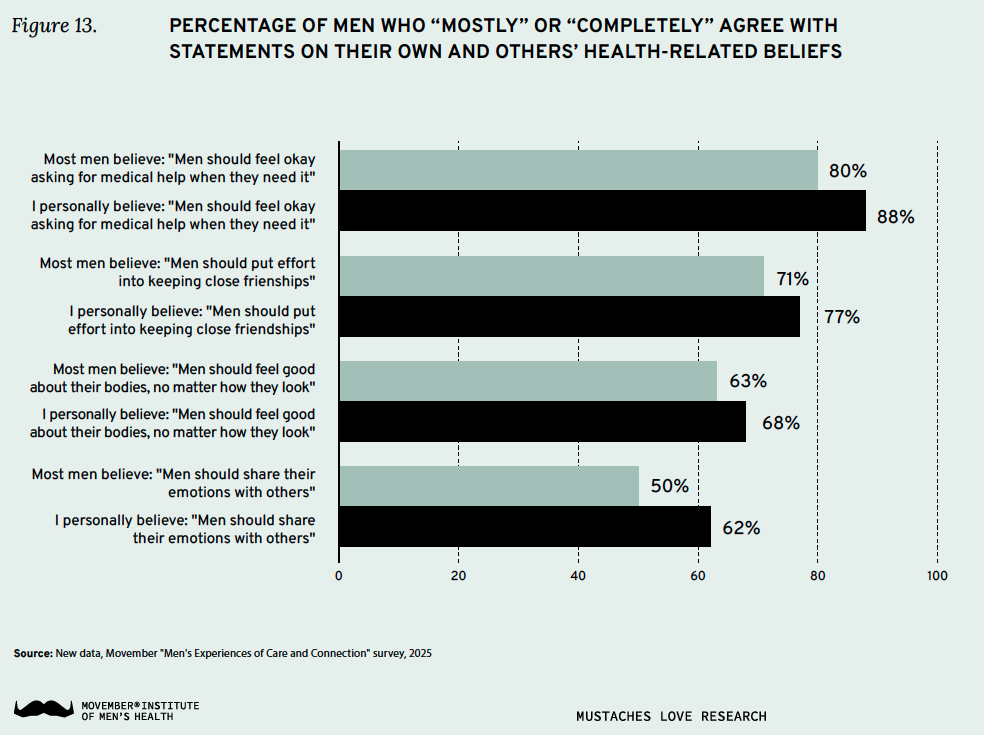
Among the many topics covered in Movember’s The Real Face of Men’s Health report, I kept thinking about the graphic on page 52, which offers clear evidence of this same disconnect on a broader scale. When asked about health-related beliefs, men consistently rated their own attitudes as more open and caring than what they believed other men think. For example, 88% of men agreed that “men should feel okay asking for medical help when they need it,” but they estimated only 80% of other men would agree. The pattern repeats across domains—friendship, body image, and emotional expression. Men think their peers are less caring, less self-accepting, and less open than they truly are. This is the relational gap of my stocism spiral made visible.
The Perception Gap: How False Norms Reinforce Silence
These findings reveal how pluralistic ignorance plays out in real time. Men hold compassionate, pro-health beliefs but wrongly assume they’re outliers. They underestimate the empathy of their peers, misjudging the culture around them as less accepting than it actually is. This perception gap reinforces silence: if I think others will mock me for caring about my health or for seeking support, I’m less likely to act on those values—even when those others are quietly thinking the same thing.
Layered onto this is precarious manhood. The sense that masculinity is always being measured and can be lost through perceived weakness. Men feel pressure to protect an image of competence, even if it costs them connection or care. Together, these forces create the illusion that self-reliance equals strength and that seeking help risks social standing.
The result is not a lack of empathy, but a lack of permission. Men don’t reject care. They hesitate because they’ve learned that vulnerability feels dangerous. That hesitation, multiplied across millions of interactions, becomes a cultural pattern.
The Social Context: Where the Gap Grows
The environments men move through (i.e., teams, workplaces, families, and online spaces) act like mirrors. They reflect and reinforce what behaviors seem acceptable within that setting. Psychologist Kurt Lewin once described human behavior as emerging from the interaction between the person and their *life space, *the psychological and social contexts that shape our actions. The same idea applies here: social settings send subtle signals about what is safe to express and what is better left unsaid.
When humor, competition, or stoicism dominate these spaces, they widen the perception gap. Silence looks like agreement, and agreement becomes the unspoken rule. Men who value honesty and care may suppress those instincts if they sense that vulnerability won’t be reciprocated or rewarded.
Movember’s data reveal that men’s private beliefs already lean toward care and connection. What’s missing is social reinforcement, an environment that mirrors those beliefs back. Modeling openness, sharing stories, and normalizing empathy can gradually reshape these contexts, but doing so is neither simple nor guaranteed. Before men can begin to see their real values reflected around them, it requires sustained effort, trust, and cultural readiness for change, rather than the outdated stereotypes they’ve acquired in the status quo.

AI image of contextual variation. Even a scenario where you hang a picture of your brief case on the wall. :)
The Relational Consequences
The ripple effects of this misunderstanding run deep, shaping men’s health and relationships in ways that are both personal and systemic. When cultural expectations prize stoicism over self-care, men learn to equate silence with strength and self-sacrifice with loyalty. Over time, this pattern accumulates into measurable harm:
Physical health: Men delay medical care or downplay symptoms to maintain a façade of toughness.
Mental health: They underreport stress or depression, believing others cope without help.
Social connection: Friendships weaken as emotional honesty feels unsafe or out of place.
These outcomes don’t arise from apathy or indifference. They are the predictable costs of a culture that misunderstands what men truly value. Many men act as if the culture of care they want doesn’t exist, when in fact, it lives quietly within them and those around them. The real challenge is to make visible what has too long remained unspoken.
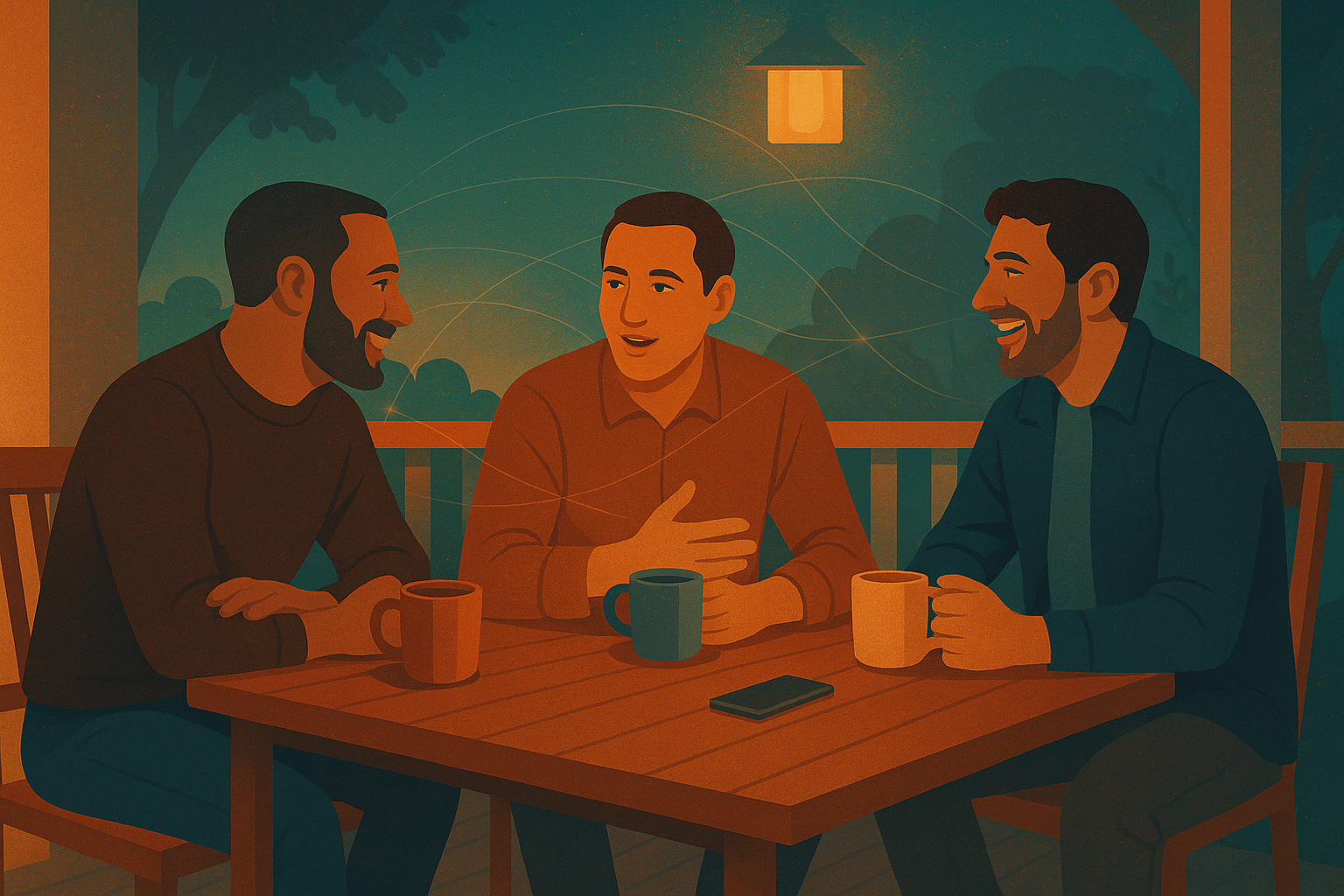
AI image of men having an open conversation about challenges.
Reframing the Solution: Talk to Your Friends
Closing the relational gap doesn't begin with grand gestures but with small, intentional acts of connection. The highly acclaimed book, “Talk to Your Boys” (Schroeder & Pepper, 2025) offers a parents with a combination of research and practical steps toward engaging boys about the things our parents should have asked us many decades ago. Considering the practicality of this book, maybe it's time to craft a parallel book titled, “Talk to Your Friends,” that provides men with the prompts and low-risk high-reward engagement suggestions. The design could build over months, even years, from covert questions or subtle hints to having a serious discussion with more than 2 people. I can sense a podcast on this coming soon.
Joking aside, these are not easy habits to build. Men are socialized to mask discomfort and read the room for cues about what is safe to share. Shifting that culture takes time and collective effort. It demands spaces that reward curiosity and compassion as much as confidence.
Men already hold the relational values we hope to see more of. What’s needed is:
Collective permission – signals from peers that expressing care won’t cost belonging.
Relational scaffolding – spaces and rituals that make emotional honesty part of everyday interaction.
Institutional mirroring – leadership and systems that demonstrate vulnerability as a form of integrity, not weakness.
Each conversation that brings empathy into view, no matter how modest, helps to erode the illusion of isolation and reaffirms that strength and openness can coexist.
Building Relational Ground
Men’s well-being is not a matter of motivation but of mirroring. The *relational gap, *between what men believe and what they think others believe, narrows when we make care visible, shared, and celebrated.
When connection replaces performance as the social baseline, men don’t lose their strength, they expand it. The future of men’s health lies not in teaching men to care, but in showing them that they already do, together.
