Growing Up in the Gray Area of Need
What Welfare, Free Lunch, and a Few Early Moments Taught Me About Poverty, Judgment, and Care
Lately, I’ve found myself thinking more and more about food assistance programs (SNAP, free school meals, expanded child tax credits) because they’ve been front and center in the news. For decades, we’ve heard the divisive rhetoric surrounding government assistance. Yet, when these recent stories come across my feed, they hit differently. Not because of the policy debates themselves, but because my focus on the health and wellbeing of boys and men reminds me of how some important and confusing moments of my childhood impacted my approach to adulthood and how I define being a man. The moments reflected how a single mother and her family managed, thanks in large part to government assistance. Yet, while we received this assistance the accompanying sense of shame was not imagined, it was real.
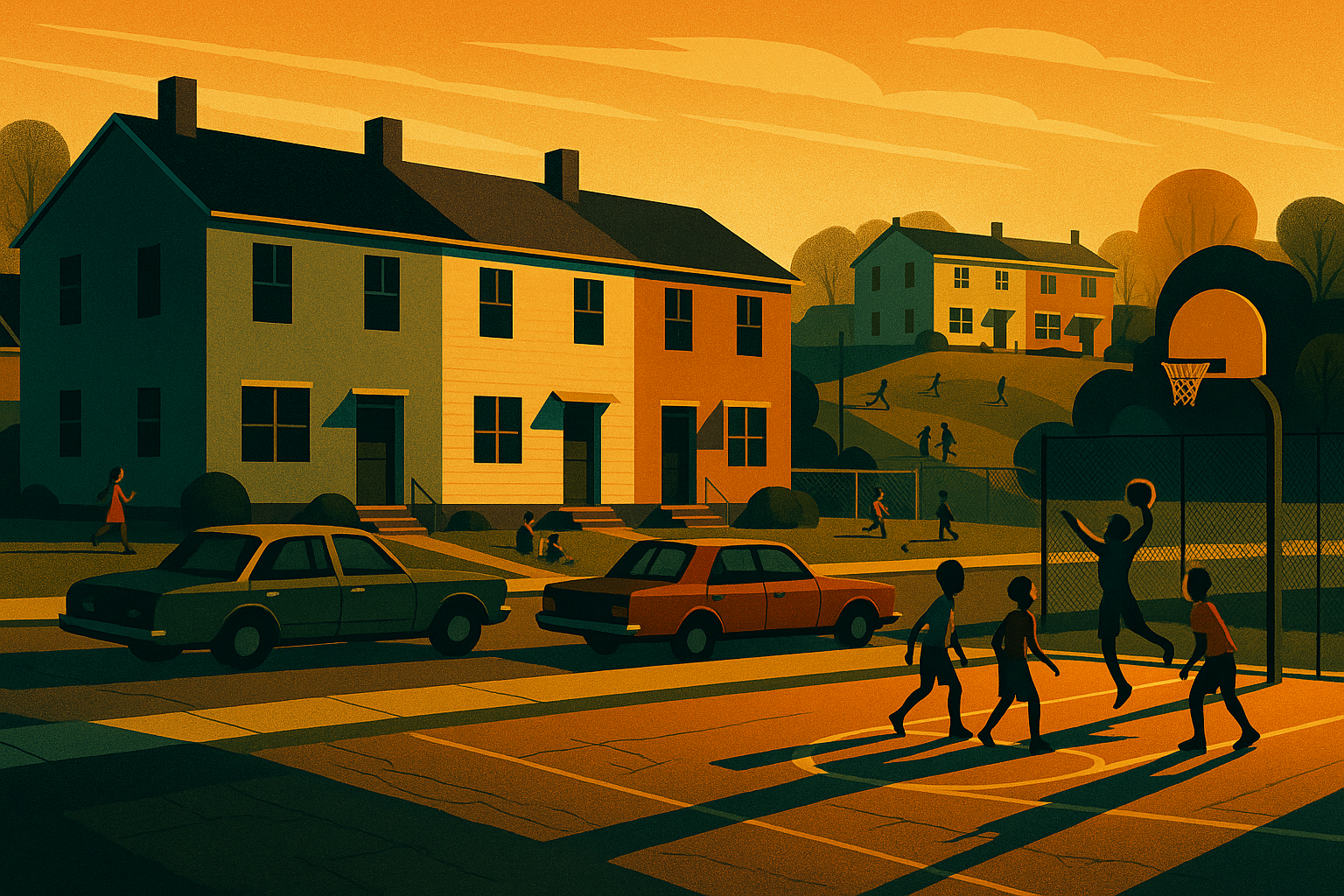
A large portion of my childhood took place in government housing. Food stamps and the free lunch program were part of the architecture of my childhood. They kept us afloat in ways I didn’t fully understand then. As an adult, I can see that items like the giant block WIC cheese and can of powdered milk helped my mom stretch her budget so she could pay rent. These foods were complemented by meals at my grandparents, family providing rides to appointments (we didn’t have a car), and moments where I saw people hand my mom a couple of bucks for the benefit of myself and my sister. Those handouts were kind and helpful, but it still wasn’t enough. Free breakfast and lunch meant I didn’t have to worry about going through an entire school day on an empty stomach. From my perspective, these programs worked exactly as they were designed to.
Yet the way the world outside of our immediate circle reacted to people like us, people who needed help, added layers of confusion and embarrassment that I carried silently for years. I lived in what I’ve come to call the “gray area of need,” a place where you feel the impact of poverty without having language to describe it, where you learn the social rules before you even know what they mean.
Lunch Cards
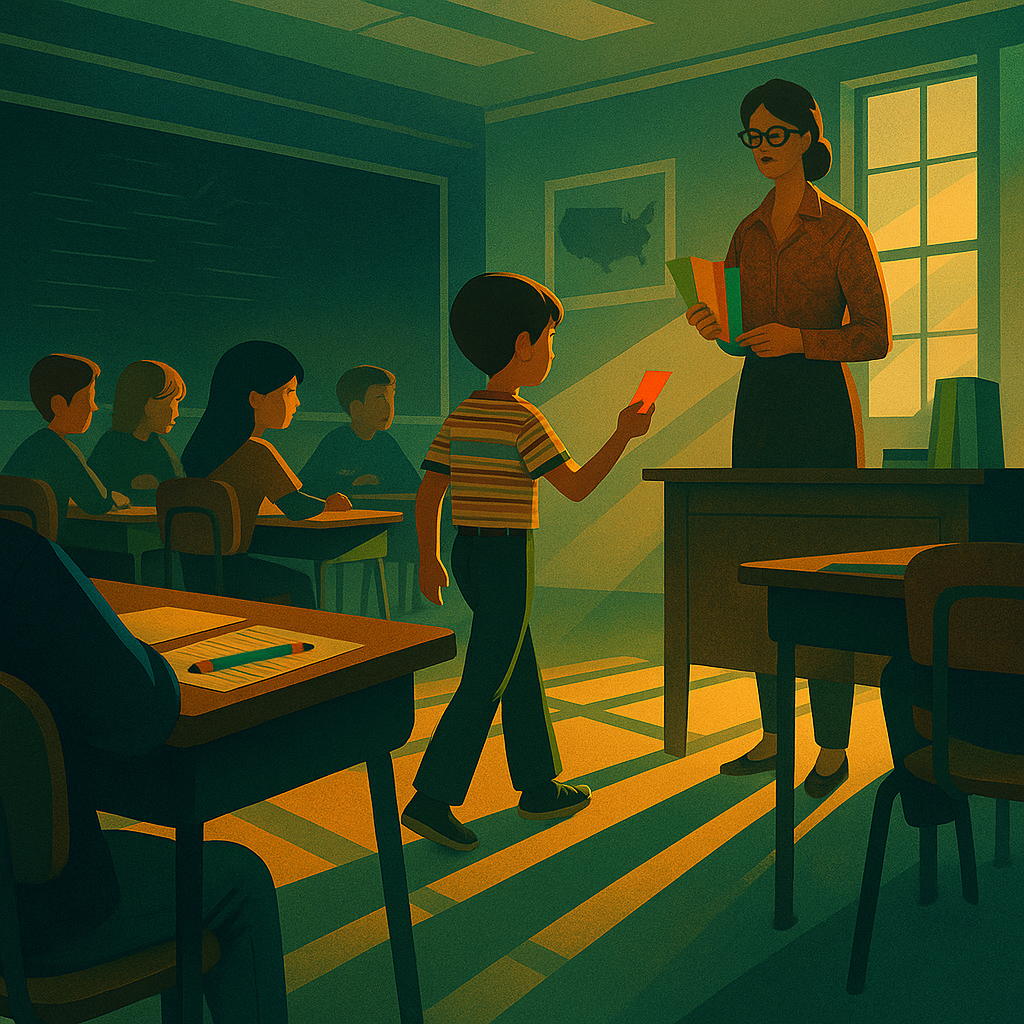
One of my earliest memories of the “gray area” occurred daily in homeroom. There were several kids on free or reduced lunch in Fitchburg, MA. Every morning, the teacher would call out the students one-by-one on to collect their lunch cards. This was the 70’s and 80’s and there was no discretion about handing out these cards, as the classroom buzzed about the latest movies, games, or what happened in the school yard before the bell. When your name was called, you’d stand up, walk to her desk and take your lunch card.
As a former school teacher, I know that most kids probably never noticed what was happening at the front of the room. As a kid, I imagined the eyes on my back, singling me out at a time of life when all you want to do is fit in. A quick, “Thanks!”, and I’d sweep my lunch card from the top of the desk, jam it in my pocket, and smack a friend in the back of the head as I walked back to my desk. Returning things to “normal”.
This was my first lesson in public assistance being made public. Technology wasn’t the same as today. Laminated construction paper with names and numbers on them was the tech. This was at a time when everyone knew everyone in a school. Maybe there could have been another way to manage this service? For me and my free-lunch cohort, the service was a lifeline that came with an unintended cost of being marked. It taught me, long before I had the language for it, that the world differentiated between the kids who had enough and the kids whose families didn’t.
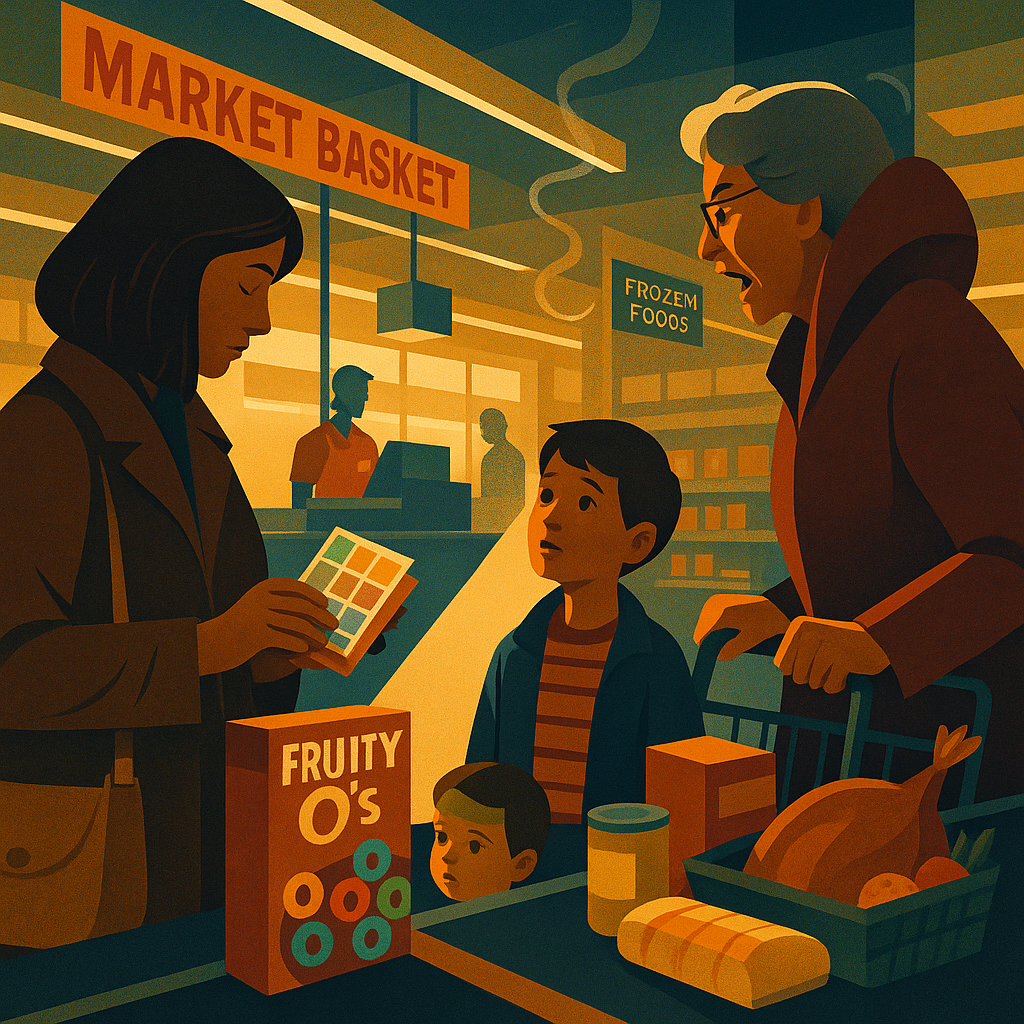
Des Moulas Market Basket scene. Learn more about this store and the worker loyalty and longstanding employment that this company enjoys (here).
Checking Out at The Basket
Standing in line with my mom at the Des Moulas Market Basket on Water St., I was feeling good. Earlier in the trip, I begged her for Fruit Loops. We always got generic Cheerios, not brand named, and never the honey nut flavor. For some reason, I had it in my mind that I needed to have Fruit Loops and made quite a stink in the isle. My persistence paid off and she grabbed the generic fruit loops. You know, the kind with faded loops and a name like, “Fruity O’s”. A name that was corny enough that you and your friends would laugh about in the school yard, but in the privacy of your own kitchen they crushed those dusty generic Cheerios. Getting that box of cereal was a win.
At the check out line, my mom rifled through her giant bag, found her booklet of food stamps and waited for the cashier to ring us up. As we waited, the woman behind us began loudly criticizing my mom for using food stamps to buy “sugary cereal.” She said it as if my mom were stealing something, or gaming the system, or committing a type of moral failure. I saw a tear run down my mom’s cheek while she said nothing.
This was the late 70’s. There was no social media, 24 hour news cycle, or a chance to video-tape the encounter. I’m 55 years old, and I could tell you that this white asshole had a large maroon winter coat on, with fur around the hood - it was winter time. Her cart was filled with groceries, including a turkey. Her left hand had a fake expensive oval shaped ring. She wore glasses that had a lanyard and she had curly brown/gray hair, and was tall. She looked like she was in her 60’s in 2025, but in 1977, she was probably 40. Her mouth was big, and loud. From 10 feet away, she smelled like cigarettes, specifically Marlboro Lights. I promise you that I could pick her out of a lineup today with 100% accuracy.
All of those details aside, I couldn’t tell you exactly how I felt in that moment, but it included elements of shame or embarrassment, guilt, rage, and most of all confusion. I wondered:
Why does she care about what we are buying?
Why are my mom’s food stamps important to her?
The groceries went on the belt, my mom didn’t respond, and the moment passed. But it didn’t pass for me. It settled somewhere deep, reinforcing an idea I was already learning: poverty doesn’t just limit your choices; it invites public surveillance. People feel entitled to police families who need help in ways they’d never dare with others.
Understanding It Now
As an adult, especially one who works in public health and thinks often about how systems shape people’s lives, I see these moments differently.
I see the courage in my mom’s constant balancing act, making decisions under duress while shielding me from most of the stress. I understand that food stamps wasn’t a sign of failure; it was evidence of a system doing its job. I understand that free lunch didn’t expose me; the school’s process did.
And I’ve learned that the shame I carried was never mine to own. It belonged to adults who showed their asses, to systems that didn’t prioritize dignity, and to cultural narratives that treat poverty as a personal defect rather than a social condition.
Programs like SNAP and free school meals are some of the most effective, research-backed tools we have for reducing childhood hunger and improving health and learning outcomes. The data is clear. The benefits are real. The problem has never been the program, it’s the stigma. More specifically, its the people who exploit the stigma for personal gain.
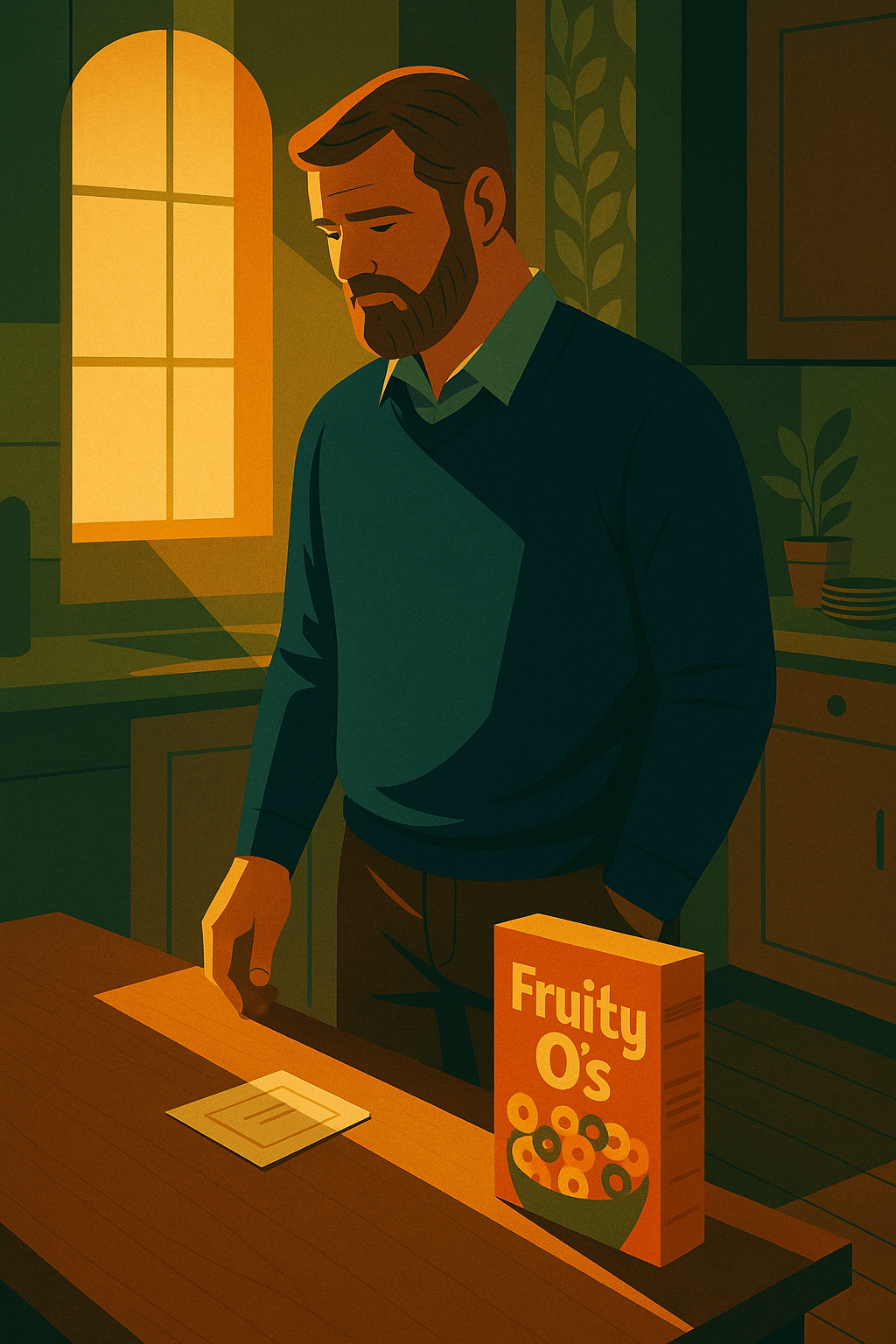
AI generated image of me remembering my Fruity O’s. ;)
Reclaiming Purpose from Poverty’s Lessons
For a long time, I thought those moments in classrooms and the grocery store were signs that something was wrong with us. Now I see that those moments shaped my purpose. They shaped the lens I use when talking or writing about boys’ and men’s health, and why I spend my life trying to build systems that give men real pathways to belonging, meaning, and care.
Growing up with limited resources taught me something many men are seldom taught: interdependence isn’t weakness, it’s survival. No man thrives alone. No family thrives alone. Every one of us is held up by networks we didn’t build entirely by ourselves.
If I’m honest, the boy standing in line at Market Basket is still part of me. He reminds me why dignity matters. Why men, women and children deserve systems that support—not shame—them. And why the future of men’s health must be relational, not punitive; caring, not judgmental; liberating, not limiting.
Because every boy deserves a path to manhood that isn’t defined by how well he hides his struggles, but by how deeply he is allowed to belong.
