Tying Up Lions
An Ethiopian proverb, ovarian cancer survivors, and a different understanding of strength

Yesterday, I spent several hours in the Phipps building on the Johns Hopkins Hospital campus. Our Outsmart Ovarian Cancer team listened to survivors describe their ordeal on film. The women described the typical benchmarks of a cancer experience: diagnosis, surgery, chemotherapy, fear, uncertainty, and recovery. They also described the upheaval that cancer brought into their lives and the difficult decisions they faced along the way. Woven throughout their stories were the physicians who guided them, the nurses who cared for them, the friends who showed up, and the family members who stayed close when life became difficult.
The drive back to Arlington is the longest and often most crowded 38 miles anyone could experience. While on the road, I listened to an episode of The Ezra Klein Show about the rise of traditionalist and masculinist movements.
At first, these experiences seemed completely unrelated. One involved women navigating a life-threatening illness. The other focused on contemporary debates about masculinity, identity, and politics.
But as I listened, I realized both conversations were wrestling with the same question:
What do people do when life becomes difficult?
The cancer survivors faced undeniable crises. Cancer is not an abstract concern, and ovarian cancer remains one of the deadliest forms of cancer affecting women. Cancer is not a cultural debate. In many ways, it is not a political talking point. It is a direct confrontation with uncertainty, suffering, and mortality.
Yet what stuck with me most was not the severity of their illness. It was how they described what happened after they were diagnosed.
These women did not deny their fear. They spoke openly about being scared, overwhelmed, and uncertain. Some described moments of grief and despair. Others talked about anger, frustration, and sadness.Yet they rarely described themselves as victims. Instead, they talked about their actions.
We heard stories about learning about the disease and the treatment process they experienced. We heard descriptions of the thoughts and motivations behind difficult decisions. We heard how respondents discovered strengths they did not know they possessed. And every one of them described asking for help when they needed it and accepting support when it was offered.
They talked about relationships.
Again and again, the conversation returned to other people:
A physician who took the time to listen.
A nurse who explained what was happening.
A spouse who never left.A friend who drove them to appointments.
A pastor who prayed with them.A support group that helped them feel less alone.
Their stories were not stories of individual triumph. They were stories of connection.

Connections
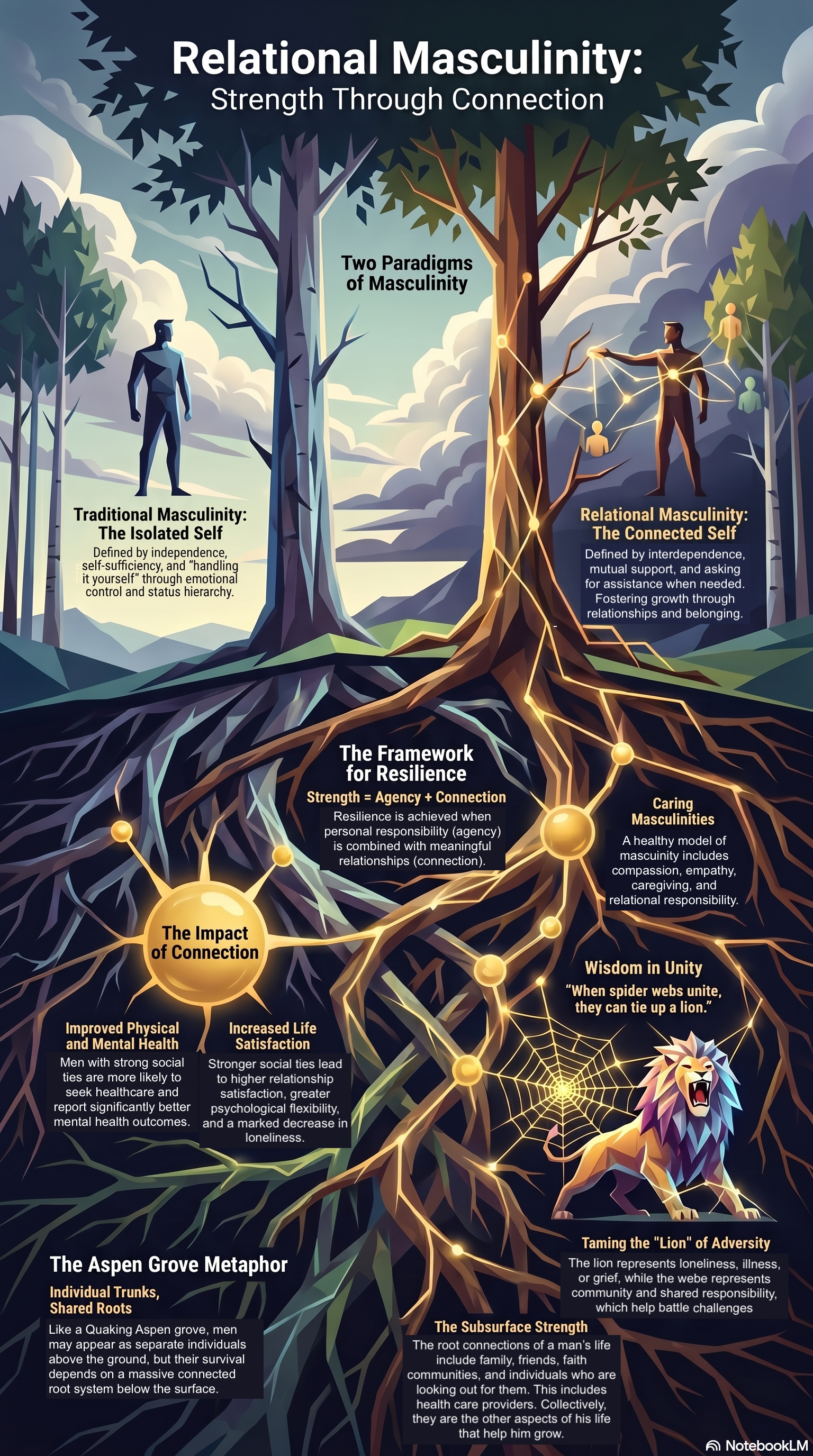
As I reflected on those interviews, I was reminded of an important insight from masculinity research. Human beings are not isolated individuals moving through the world alone. We are fundamentally relational. Our identities, behaviors, and beliefs develop through our relationships with families, friends, communities, and institutions (Courtenay, 2000; Häyrén & Wahlström Henriksson, 2016).
This may seem obvious, but it stands in sharp contrast to many popular conversations about masculinity.One recurring theme in masculinity research is the cultural ideal of autonomy. Men are often encouraged to be self-sufficient, independent, emotionally controlled, and capable of solving problems on their own. Strength is frequently defined as needing no one and relying on nothing beyond oneself (Elliott et al., 2022).
Yet the reality of human life is different.
The relational masculinity literature argues that relationships are not obstacles to strength. They are often the foundation of it. Human beings become resilient not by escaping dependence on others but by participating in networks of care, support, accountability, and belonging (Di Bianca & Mahalik, 2022; Elliott, 2016).
The cancer survivors either understood this intuitively or learned it through experience. They did not view accepting help as weakness, vulnerability as failure, or dependence on others as evidence that they lacked strength. Instead, they treated connection as a resource.
Hearing their stories shaped how I listened to Ezra and Helen on the podcast later that day. To be fair, the podcast acknowledged many real challenges facing boys and men. Loneliness, social isolation, educational struggles, uncertainty about identity, and declining social connections are all genuine concerns. These issues deserve serious attention.
A Different Interpretation of Men’s Challenges
Yet what struck me was not the discussion of men’s struggles themselves. Klein and Lewis repeatedly acknowledged that boys and men face genuine challenges and uncertainty about identity. What stood out was the way some of the masculinist thinkers discussed in the episode interpreted those challenges through the language of hierarchy, status, and cultural loss.
The podcast identified a problem that sounded remarkably familiar. Again and again, Klein and Lewis returned to themes of loneliness, social disconnection, declining friendships, and uncertainty about belonging. Many men today report having fewer close relationships and less social support than previous generations.In that sense, the podcast and the survivor interviews were describing different expressions of the same underlying challenge.Where they diverged was in the proposed response.
Some of the masculinist thinkers discussed in the episode framed status, hierarchy, and the restoration of traditional social roles as remedies for disconnection. The cancer survivors pointed in a different direction. Faced with adversity, they strengthened relationships, accepted support, and deepened their ties to family, friends, healthcare providers, faith communities, and fellow survivors.
Many of the women described adversity through a framework of agency:
What can I do?
Who can help?
How do I move forward?
How do I find meaning in this experience?
Those questions encouraged action rather than blame.
Their answers echoed a pattern often heard from successful leaders, entrepreneurs, and public figures who attribute their achievements not solely to individual talent or determination, but to the support of mentors, partners, colleagues, friends, and family (and frequently, luck). Many self-reflective CEOs describe trusted teams, angel investors, and advisors as essential to their success. Even accomplished athletes, artists, and researchers frequently credit coaches, collaborators, and loved ones for helping them persevere through setbacks and reach their goals.
By contrast, many contemporary debates about masculinity seem to focus on questions of status and grievance.
What has been taken away?
Who is responsible?
Why do men no longer have the position they once had?
Those questions lead toward resentment and often focus on blame, status, and loss rather than relationships, agency, and connection. This distinction may help explain why some responses to adversity produce growth while others produce frustration.
Strength Through Connection
One of the ironies of the day was that the cancer survivors embodied many of the virtues that traditional masculinity often claims to value.
Courage
Endurance
Discipline
Responsibility
Perseverance
Yet they expressed those qualities through connection rather than domination. Through gratitude rather than grievance and vulnerability rather than emotional detachment.
This aligns closely with emerging scholarship on what Karla Elliott calls “caring masculinities.” Rather than defining strength through control, dominance, or emotional restriction, caring masculinities integrate emotional openness, interdependence, compassion, and relational responsibility into a healthy understanding of strength (Elliott, 2016).
The cancer survivors we interviewed were not performing masculinity. In fact, framing these qualities as masculine may miss the larger point. The traits Elliott describes (emotional openness, compassion, interdependence, vulnerability, and relational responsibility) are not inherently masculine or feminine. They are human capacities. The more we attach them to gendered categories, the more we risk reinforcing the very divisions that limit people’s ability to develop them.
I believe the challenge facing many men today is not simply a lack of status, authority, or recognition.
Rather, it is a lack of meaningful connection.
Research consistently shows that rigid adherence to traditional masculine norms can undermine relationship quality, emotional intimacy, and well-being (Burn & Ward, 2005; Fellers & Schrodt, 2021). At the same time, growth-fostering relationships built on empathy, mutuality, and trust appear to support healthier and more flexible ways of being in the world (Di Bianca & Mahalik, 2022, Shattuck, 2024).
Rendering of proverb in style of the stained glass windows by Ethiopian artist Afewerk Tekle
The cancer survivors were not talking about strength. They were the living it.
Confronting fear without denying it.
Accepting help without shame.
Maintaining hope without certainty.
Moving forward without pretending they could do it alone.
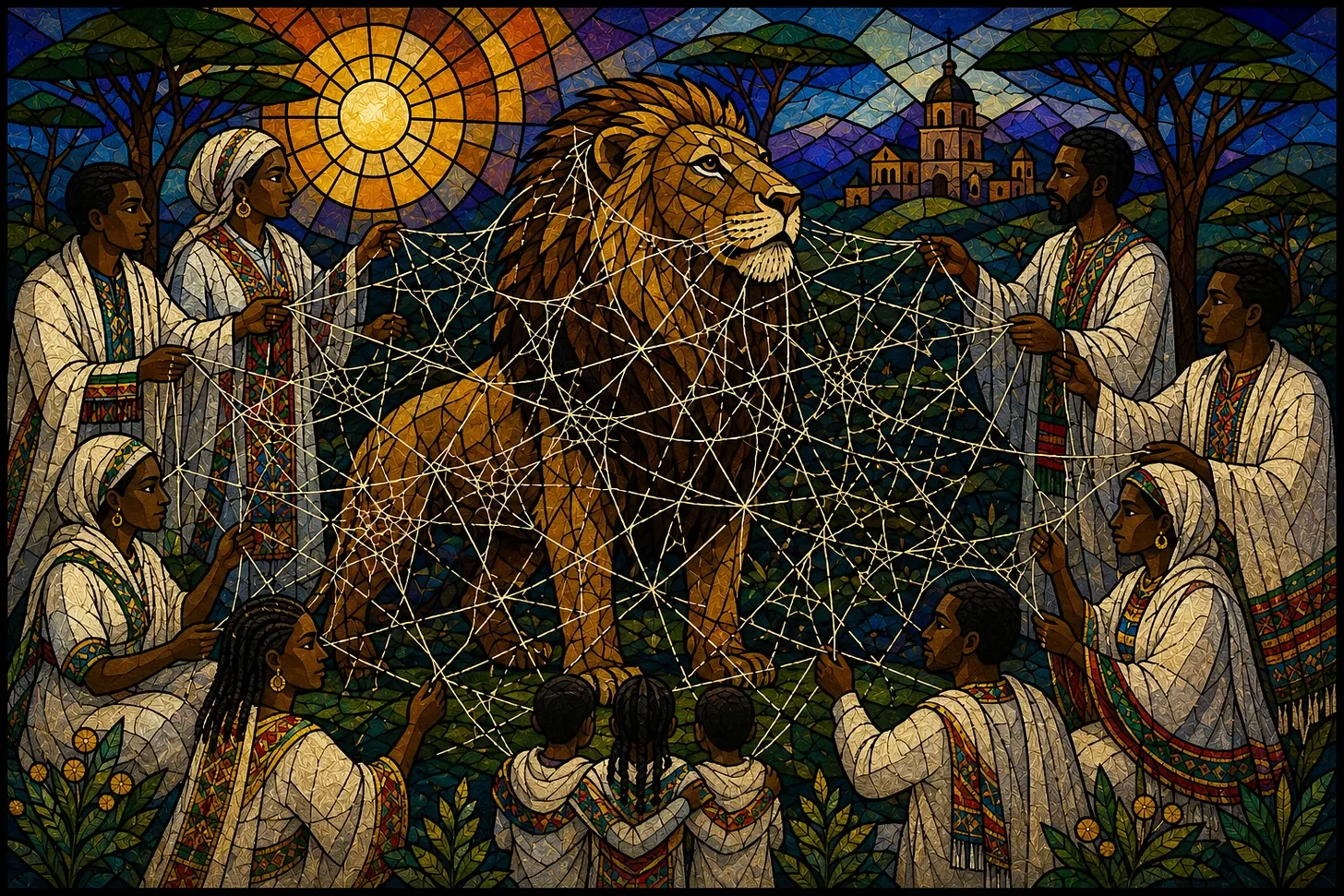
These women did not defeat cancer alone. They tied up a lion.
“When spider webs unite, they can tie up a lion.”
It is an Ethiopian proverb I learned while drinking beers with colleagues in Addis Ababa. Sometimes that lion is cancer. Sometimes that lion is loneliness. Sometimes it is grief, financial hardship, addiction, or the quiet weight of uncertainty. The proverb reminds us that even the most serious threats can be restrained when enough strands are woven together.
Looking back on those interviews, I am not sure the lesson is really about cancer or even masculinity. It is about relationships.
In a moment when so many conversations about identity revolve around status, recognition, and what has been lost, they reminded me of something simpler:
We are strongest when we are connected.
References
Burn, S. M., & Ward, A. Z. (2005). Men’s conformity to traditional masculinity and relationship satisfaction. Psychology of Men & Masculinity, 6(4), 254–263.
Courtenay, W. H. (2000). Constructions of masculinity and their influence on men’s well-being: A theory of gender and health. Social Science & Medicine, 50(10), 1385–1401.
Di Bianca, M., & Mahalik, J. R. (2022). A relational-cultural framework for promoting healthy masculinities. American Psychologist, 77(3), 321–332.
Elliott, K. (2016). Caring masculinities: Theorizing an emerging concept. Men and Masculinities, 19(3), 240–259.
Elliott, K., Roberts, S., Ralph, B., Robards, B., & Savic, M. (2022). Understanding autonomy and relationality in men’s lives. British Journal of Sociology, 73(3), 571–586.
Fellers, M., & Schrodt, P. (2021). Perceptions of fathers’ confirmation and affection as mediators of masculinity and relational quality in father-child relationships. Journal of Family Communication, 21(1), 46–62.
Häyrén, A., & Wahlström Henriksson, H. (Eds.). (2016). Critical perspectives on masculinities and relationalities: In relation to what? Springer.
