Mapping Boys’ and Men’s Health Policy Activity Across the United States (2015–2026)
States are increasingly talking about boys’ and men’s health. The harder question is whether they are building systems capable of supporting it.

Introduction
Over the past decade, policymakers across the United States have increasingly introduced legislation, commissions, initiatives, proclamations, programs, and public reports related to boys’ and men’s health and well-being. Although these efforts remain fragmented and uneven, the growing volume and diversity of policy activity suggest that boys’ and men’s issues are becoming more visible within state and federal policy conversations. The findings also suggest growing interest in developing more coordinated approaches to boys’ and men’s health-related policy activity across multiple sectors.
Much of this activity has emerged through policy domains such as mental health, suicide prevention, fatherhood, violence prevention, educational outcomes, and preventive health promotion. In some states, policymakers have also proposed or developed governance-oriented initiatives designed to coordinate long-term policy attention toward boys and men.
At the same time, the broader policy landscape remains weakly institutionalized. Most states still lack dedicated infrastructure capable of integrating mental health, prevention, education, workforce participation, family well-being, and broader public health coordination into sustained boys’ and men’s health strategies.
This paper presents an exploratory scan of boys’ and men’s health-related policy activity identified across all 50 states between 2015 and 2026. Rather than functioning as a formal legal review, the analysis maps emerging areas of policy attention, governance experimentation, and institutional engagement related to boys’ and men’s well-being.
The findings suggest that boys’ and men’s health-related policy activity is expanding across the United States, but much of this activity remains fragmented, symbolic, unevenly developed, or limited in long-term governance infrastructure.
Overview of the Exploratory Policy Scan
Origins of the Scan
This exploratory policy scan emerged from an initial review of proposed federal boys’ and men’s health legislation, including HR 7602, and expanded into a broader 50-state assessment of boys’ and men’s health-related policy activity occurring between 2015 and 2026.
The project sought to describe the frequency and variety of policy actions related to boys’ and men’s health implemented over this timeframe within state-level legislative, administrative, and public health systems.
Search Approach
The scan used an iterative ChatGPT-assisted workflow combined with partial manual review of official government sources. Searches were conducted in groups of no more than five states at a time to reduce model overload and improve consistency. The workflow instructed the model to search official state legislative websites, department of health websites, executive branch announcements, strategic plans, appropriations documents, commissions, public reports, and administrative materials related to boys’ and men’s health and well-being.
Policy activity categories included:
proposed legislation,
laws and statutes where identifiable,
proclamations and resolutions,
agency initiatives,
public programs,
commissions and advisory councils,
strategic plans,
funding announcements,
public reports,
and governance-related proposals.
Searches focused on policy activity related to:
men’s health,
boys’ and men’s health,
mental health and suicide prevention,
fatherhood and paternal engagement,
preventive health,
violence prevention,
boys’ educational outcomes,
workforce participation,
social isolation,
and broader well-being.
Policies were included when boys, men, fathers, male youth, male students, or male populations were explicitly referenced within policy language, target populations, implementation strategies, or intended beneficiaries. Some broader policies were also included when boys and men appeared as clearly identified beneficiary groups. Partial manual review was conducted throughout the process, including validation of policy titles, verification of source links, and direct inspection of selected legislative and agency documents, particularly policies from Connecticut, Virginia, Illinois, Maryland, and North Dakota, as presented below.
Important Limitations
This paper should be understood as an exploratory policy scan rather than a systematic legal review or comprehensive legislative audit.
Several important limitations should be noted:
legislative status was not comprehensively verified for every policy action,
duplicate policy entries were not fully audited (i.e., companion House and Senate bills referring to the same initiative, or the same initiative appearing as both a legislative proposal and an agency program),
policy actions varied substantially in authority and implementation,
and some identified initiatives may have evolved, stalled, or changed after initial identification.
As a result, the dataset should not be interpreted as a definitive inventory of enacted laws. Instead, it is best understood as an exploratory map of policy attention and policy activity related to boys’ and men’s health across the United States.
Despite these limitations, the scan still provides insight into how policymakers are increasingly engaging boys’ and men’s issues in the last 10 years across multiple domains.
Understanding Policy Activity: Symbolic vs Structural Engagement
The policy activity identified in the scan varied substantially in scope, authority, and implementation capacity. Some actions primarily reflected symbolic recognition and agenda-setting activity, while others suggested more durable forms of institutional engagement.
Symbolic Recognition Activities
Symbolic activities included:
proclamations,
awareness resolutions,
recognition statements,
and ceremonial declarations.
These actions were treated as entry-level indicators of policy recognition rather than evidence of long-term governance infrastructure. Although symbolic actions often carried limited implementation authority, they still reflected increasing public visibility and willingness among policymakers to engage boys’ and men’s issues.
Structural Policy Activities
Structural policy activities included:
commissions,
advisory councils,
departmental programs,
reporting systems,
administrative initiatives,
strategic plans,
and broader governance-related proposals.
These activities suggested greater institutional engagement because they involved implementation systems, coordination mechanisms, reporting structures, or longer-term administrative activity. The distinction between symbolic and structural engagement became one of the clearest patterns identified throughout the scan. Many states demonstrated symbolic recognition activity, while only a smaller number appeared to move toward more sustained governance-oriented approaches.
Major Areas of Policy Activity
The final exploratory database identified approximately 225 state-level policy actions across all 50 states between 2015 and 2026.
The strongest area of activity involved mental health and suicide prevention, accounting for approximately 108 identified policy actions. Gender-based violence prevention and perpetrator intervention represented approximately 59 actions. Fatherhood and paternal engagement accounted for approximately 27 actions, while preventive health and men’s health promotion represented approximately 22 actions.
These categories frequently overlapped, and many policy actions addressed multiple issues simultaneously. The inclusion of policy activity within these domains should not be interpreted as evidence that the identified policies reflected best practices, demonstrated effectiveness, or were fully aligned with boys’ and men’s health priorities within the geographic areas. Instead, the categories were intended to map areas of emerging policy attention and institutional engagement related to boys’ and men’s issues.
Link to spreadsheet with state-level legislation organized by topic area.
Mental Health and Suicide Prevention
Mental health and suicide prevention emerged as the largest area of identified policy activity.
The scan identified policy activity related to:
suicide prevention,
988 implementation,
crisis-response systems,
school-based mental health,
behavioral health access,
and men’s mental health awareness.
The findings suggest that mental health may function as a politically visible and actionable entry point into broader boys’ and men’s policy conversations.
At the same time, some of this policy growth likely reflected broader post-pandemic expansion of behavioral health systems occurring across the United States. Expansion of 988 systems, school mental health initiatives, and behavioral health infrastructure was not necessarily designed exclusively as boys’ and men’s health policy, although boys and men frequently appeared as clearly identified beneficiary populations within many of these initiatives.
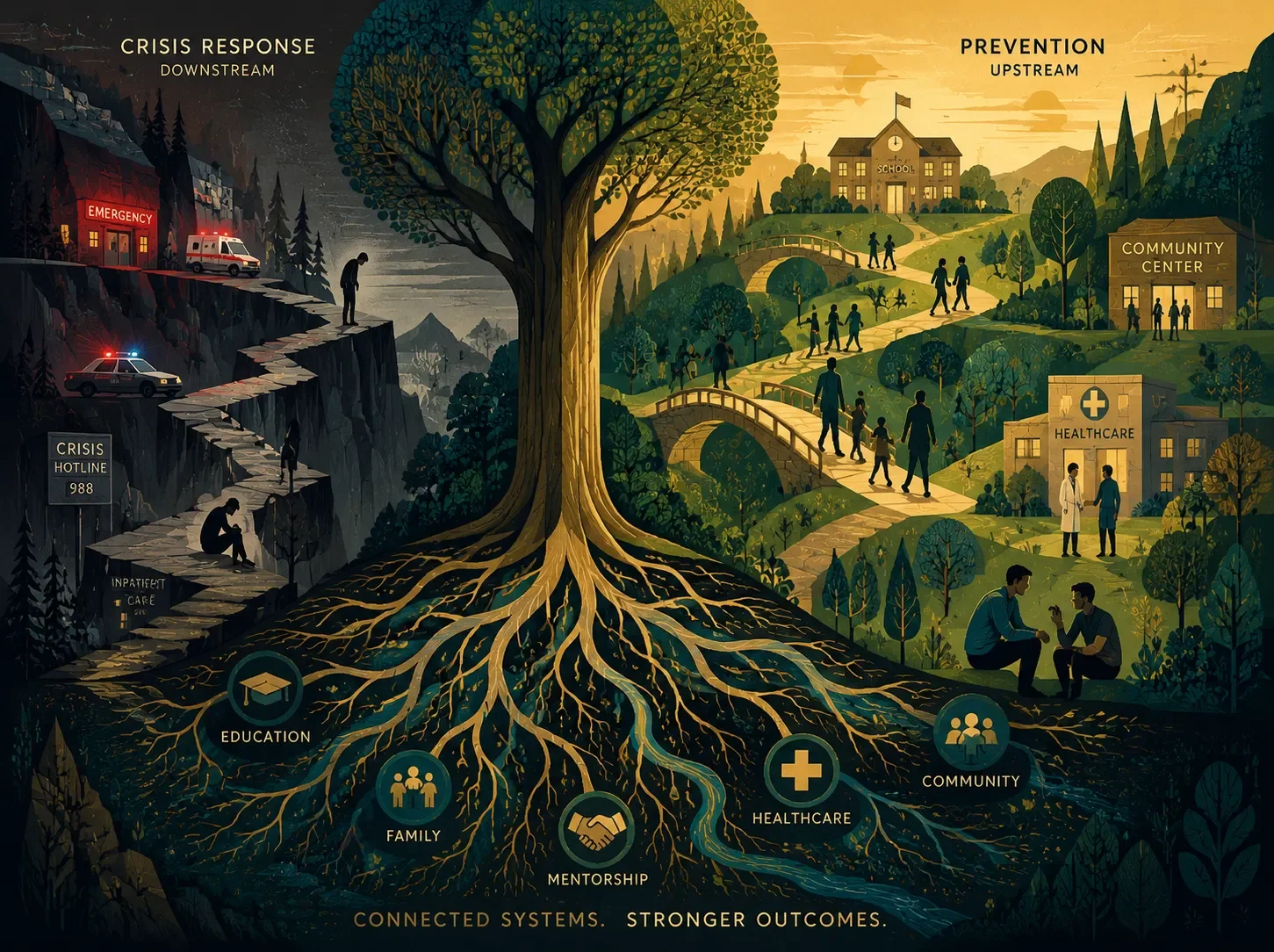
The concentration of activity within mental health also highlighted an important pattern: policymakers often appeared more prepared to respond to visible crises than to build long-term preventive systems focused on belonging, prevention, and sustained health engagement.
Gender-Based Violence Prevention
Gender-based violence prevention and perpetrator intervention represented another major area of activity.
The scan identified policy activity related to:
batterer intervention,
violence prevention programming,
accountability systems,
perpetrator rehabilitation,
and community-based prevention initiatives involving men and boys.
These policies often framed boys and men within broader discussions of accountability, public safety, family well-being, and violence prevention. Men as victims of violence were not accounted for in this analysis.
Fatherhood and Paternal Engagement
Fatherhood and paternal engagement also emerged repeatedly throughout the dataset.
These initiatives frequently focused on:
paternal involvement,
parenting support,
responsible fatherhood,
workforce participation,
and family-centered programming.
Although many fatherhood initiatives were not explicitly framed as men’s health policy, they often identified fathers and male caregivers as central target populations and reflected growing recognition of paternal involvement within broader family and community systems.
Preventive Health and Men’s Health Promotion
Preventive health represented a comparatively smaller but still important area of policy activity.
The scan identified policies related to:
cancer screening,
cardiovascular health,
preventive healthcare utilization,
public awareness campaigns,
and broader men’s health promotion.
Compared to crisis-response systems and behavioral health initiatives, preventive health infrastructure appeared considerably less developed across most states.

Three Overlapping Patterns of Policy Development
When the policy activity identified throughout the scan was reviewed collectively, several broader patterns began to emerge.
These patterns were overlapping, interpretive, and not universal across all states. States did not follow a single linear pathway. However, the findings suggest that boys’ and men’s policy activity frequently clustered around three broad forms of engagement:
symbolic recognition,
crisis-oriented mental health responses,
and emerging governance-oriented activity.
Pattern 1: Recognition Without Infrastructure
One of the earliest and most widespread forms of activity involved symbolic recognition.
Across the dataset, states issued proclamations, awareness resolutions, Men’s Health Month declarations, and public statements acknowledging issues affecting boys and men. These actions often had limited implementation authority, but they still appeared politically significant because they publicly recognized boys’ and men’s issues as legitimate areas of policy concern. The findings suggest that symbolic recognition frequently preceded more structural forms of policy engagement. At the same time, many states appeared to stop at symbolic recognition rather than developing long-term implementation systems, recurring funding mechanisms, or governance infrastructure.
Pattern 2: Mental Health as a Policy Entry Point
The second major pattern involved mental health and crisis-response systems.
Mental health appeared repeatedly throughout the dataset as one of the most politically visible and actionable domains related to boys and men. Policymakers often appeared more willing to engage:
male suicide,
emotional isolation,
school disengagement,
behavioral health,
and crisis-response systems
than broader conversations related to masculinity, social disconnection, or long-term public health infrastructure. The findings suggest that the public concern around mental health may function as an entry point into broader boys’ and men’s policy conversations because the issue is both urgent and publicly visible. However, many identified policies still focused primarily on downstream crisis response rather than upstream prevention or long-term community connection.
Pattern 3: Emerging Governance Structures
A smaller but highly significant group of policy activities involved emerging governance-oriented proposals and institutional structures.
These activities included:
commissions,
advisory councils,
men’s health programs,
reporting systems,
and broader coordination initiatives.
Although comparatively uncommon, these activities suggested growing interest in building systems capable of sustaining policy attention over time. The findings suggest that only a relatively small number of states demonstrated evidence of more coordinated governance-oriented engagement related to boys’ and men’s well-being.
Men’s Health Mini-Case Studies
The paragraphs below provide a slightly more detailed, though still incomplete, description of the types of policy activity identified throughout the scan. These examples illustrate how some states experimented with symbolic recognition, public health programming, governance-oriented proposals, reporting systems, and broader institutional engagement related to boys’ and men’s well-being.
Although these examples should not be interpreted as comprehensive legal or implementation reviews, they help demonstrate how several states moved beyond isolated policy proposals toward more sustained structures promoting men’s health and well-being. At the same time, the examples also illustrate that this level of institutional development remained uncommon across much of the broader national landscape.
Illinois represented one of the clearest examples of preventive health institutionalization. The state established a Men’s Health Program within its public health infrastructure in 2007 and continued expanding related reporting and assessment mechanisms throughout the period covered in the scan. In 2022, the state established the Division of Men’s Health and in 2025 conducted and published an assessment of men’s health through the Department of Public Health. State policy activity emphasized preventive health, disparities, screening, and outreach. This reflected a shift away from purely symbolic recognition toward ongoing implementation and accountability.
Connecticut similarly developed a state Men’s Health Program within the Department of Public Health, with program activity continuing throughout the 2015–2026 study period. The initiative focused on awareness, preventive health promotion, screening, and public health engagement. Rather than functioning as a one-time initiative, the program became embedded within the state’s broader health infrastructure. It also reflects evolution of policy engaging boys and men from the 2015 proposed, but not enacted legislation focused on training youth in suicide prevention (HB 6276), to 2022’s fatherhood initiative (PA 22-138 / SB 289), and a proposed act in 2024 concerning on men’s health that was eventually tabled (HB 5425 / CGS 19a-6w) by this account.
North Dakota stood out because it paired symbolic recognition efforts (i.e., officially recognizing Men’s Health week, in 2025), including Men’s Health Month proclamations identified during the mid-2010s, with subsequent institutional development through a state Men’s Health Program operating within the Department of Health and Human Services. The program includes this Men’s Health Dashboard (let the PowerBI graphics load at the bottom), and established men’s behavioral health resources in 2024. Legislators also proposed two bills to enact the 988 crisis hotline program (2025 SB2200), this work started through 2023’s Suicide Fatality Review Commission (HB1390). This makes North Dakota one of the clearest examples in the dataset of a state taking “second steps” beyond awareness toward more durable infrastructure.
Maryland’s approached the issue differently through HB341, introduced in 2026, which proposed the creation of a Maryland Commission for Boys’ and Men’s Health. The legislation framed boys’ and men’s well-being as interconnected with educational outcomes, workforce participation, mental health, family stability, and community outcomes. Although the commission had a hearing on February 10th, 2026, it was not passed within this year’s political actions. The state did manage to establish the long-extinct megalodon as the Maryland’s official state shark. In addition to men’s health, I also work on ovarian cancer project. Legislation providing free salpingectomy, a preventative intervention for ovarian cancer (SB 551), was also bypassed while the megalodon had its day.
Virginia followed a somewhat similar but more institutionally advanced path through HB1188, enacted in 2026, which established the Virginia Boys and Men Advisory Commission within the legislative branch of state government. The legislation explicitly addressed educational inequity, workforce participation, health disparities, mental health, and social well-being among boys and men in the Commonwealth. The commission is one of the clearest examples identified in the scan of a state formally institutionalizing cross-sector boys’ and men’s policy coordination. Virginia’s legislation follows the 2020 “Promoting Family Reintegration in Intensive Reentry Programs” report outlining a broad set of evidence-based parenting, trauma-informed initiatives designed to strengthen family relationships, successful reentry, and reduce recidivism among incarcerated individuals (RB 430). There was also prior policy action to fund 988 calls (SB 1302 / Marcus Alert) and two pieces of legislation to put 988 crisis lines on student identification cards (§ 22.1-287.05 in 2023 & § 23.1-802.1 in 2024). Although the policies were gender inclusive, they recognized the unique needs of men who are reentering communities from incarceration and boys’ and men’s staggering suicide statistics.
Major Gaps Identified Across the Policy Landscape
Fragmented Infrastructure
One of the clearest findings throughout the scan was the fragmented nature of boys’ and men’s policy activity.
Although many states demonstrated policy attention across multiple domains, relatively few appeared to integrate these efforts into coordinated long-term systems capable of sustaining implementation, evaluation, reporting, and long-term public health planning. Policy activity often emerged through isolated proposals, agency initiatives, or issue-specific interventions rather than through broader statewide strategies focused on boys’ and men’s well-being.
Mental health initiatives frequently operated separately from fatherhood initiatives, violence prevention systems, educational policy, workforce development efforts, or preventive health programming. In many cases, these policy domains appeared to function through separate agencies, disconnected funding streams, and independent administrative structures despite substantial overlap in the populations and challenges being addressed.
This fragmentation matters because many of the challenges affecting boys and men are deeply interconnected. Suicide prevention, educational disengagement, violence exposure, social isolation, preventive healthcare utilization, and workforce instability frequently overlap within the lives of individuals and families. Yet relatively few states appeared to demonstrate sustained mechanisms capable of coordinating these domains into broader long-term public health or governance strategies.
Weak Preventive Health Infrastructure
Compared to behavioral health and crisis-response activity, preventive health infrastructure appeared considerably less developed across most states identified in the scan. Relatively few policy actions focused on sustained preventive engagement among boys and men, despite longstanding evidence that men are less likely to utilize preventive healthcare services, more likely to delay care-seeking, and more likely to engage health systems only after conditions become acute.
Only a limited number of identified policy actions addressed:
cancer screening,
cardiovascular health,
preventive healthcare utilization,
chronic disease prevention,
or broader men’s health promotion campaigns.
Many initiatives focused on downstream intervention after crises had already emerged rather than earlier investments in outreach, screening, community-based prevention, or long-term health promotion. This imbalance suggests that policy systems are often more prepared to respond to visible crises than to invest in sustained preventive infrastructure.
This pattern is particularly important because prevention shapes outcomes related to cardiovascular disease, cancer screening, substance use, mental health, educational attainment, violence exposure, and broader life expectancy disparities affecting boys and men. Although several states demonstrated awareness-oriented activities such as Men’s Health Month proclamations or screening campaigns, comparatively few appeared to establish durable systems capable of sustained outreach, coordination, evaluation, or long-term preventive public health engagement focused specifically on boys and men.

Limited Funding Transparency
Many identified policy activities lacked clearly identifiable funding structures, implementation mechanisms, recurring appropriations, or evaluation systems.
This pattern appeared across multiple domains, including mental health initiatives, awareness campaigns, violence prevention programs, and fatherhood-related legislation. In many cases, legislation established goals or commissions without specifying how implementation would be funded or evaluated over time. Current federal legislation HB 7602 proposes the establishment of a Men’s Health Office within the Department of Health & Human Services, which states that “No additional funds are authorized to be appropriated to carry out this section.”
While many initiatives lacked clearly defined long-term funding structures, the growing number of policy proposals may reflect an emerging foundation for future investment and infrastructure development. Some programs appeared to rely on pilot funding, grants, or discretionary agency support, which may allow policymakers to test approaches and build momentum before establishing recurring appropriations. Over time, sustained implementation will likely depend on continued investment in staffing, reporting systems, administrative coordination, and evaluation mechanisms that can support durable men’s health governance efforts.
Limited Cross-Sector Coordination
Boys’ and men’s issues frequently appeared across:
behavioral health,
education,
workforce development,
fatherhood,
and violence prevention.
However, relatively few states demonstrated clear mechanisms for coordinating these domains across agencies or long-term governance systems.
This lack of coordination may be particularly important during adolescence and early adulthood, when boys (and girls) are developing many of the social relationships, coping strategies, help-seeking behaviors, and institutional connections that shape health trajectories over time. Schools, sports systems, families, peer groups, workforce environments, and healthcare systems all influence how boys understand trust, emotional support, belonging, responsibility, and health engagement.
When these systems operate in isolation, opportunities for early prevention and sustained relationship-building may be lost. Boys experiencing educational disengagement, emotional isolation, violence exposure, or mental health challenges may encounter fragmented systems that address single issues without recognizing the broader relational and developmental context shaping long-term well-being.
The findings suggest that stronger cross-sector coordination could help states move beyond short-term crisis response toward more integrated systems capable of supporting healthy relationships, preventive health engagement, social connection, and long-term trust in public institutions, including the healthcare sector itself. Over time, these early experiences may substantially influence how boys and men engage healthcare systems, seek support during crises, build stable social networks, and participate within families and communities throughout adulthood.
What Comes Next?
Several broad priorities and future directions emerged repeatedly across states.
Coordination: The next phase of men’s health policy will likely require moving beyond isolated legislation toward more coordinated systems capable of sustaining long-term implementation, prevention, and accountability.
Infrastructure: Future policy efforts may need to focus more directly on durable governance structures capable of integrating mental health, preventive care, educational outcomes, workforce participation, violence prevention, and family well-being into a more coherent public health strategy for boys and men.
Governance: Several policy priorities emerged repeatedly throughout the dataset. Currently, the bipartisan proposed legislation promoting a Federal Office of Men’s Health could be capable of coordinating or providing guidance for a national strategy that includes sex disaggregated data collection, efforts to increase public awareness of male-specific health risks, and cross-agency collaboration.
Mental Health: Mental health remained the most frequently identified area of activity throughout the scan, suggesting that future policy development will likely continue emphasizing suicide prevention, behavioral health access, school-based supports, and crisis response systems while also investing further upstream in prevention, early intervention, social connection, and long-term health engagement before crises emerge.
Prevention: The scan highlighted the need for a stronger preventive health infrastructure focused on cancer screening, cardiovascular health, preventive care utilization, and men’s health promotion, particularly as most states remained far more oriented toward crisis response than long-term prevention and early health engagement.
Integration: Finally, boys’ and men’s health issues frequently appeared across education, workforce development, behavioral health, fatherhood, and violence prevention systems, yet relatively few states demonstrated mechanisms capable of coordinating these efforts across agencies or sustaining them over time.
Conclusion
The findings from this exploratory scan suggest that boys’ and men’s health-related policy activity is becoming more visible across the United States. Most states still appear to lack coordinated systems capable of integrating these domains into sustained public health infrastructure focused on boys’ and men’s well-being. Despite these limitations, the growing diversity of policy activity identified throughout the scan suggests increasing public and institutional attention toward boys’ and men’s issues across multiple policy sectors. Although many initiatives remain symbolic, proposed, fragmented, or exploratory, the findings suggest that boys’ and men’s health is becoming a more visible area of public policy conversation throughout the United States.
